
 Wellness
How Often Should You Use a Red Light Therapy Bed?
Two to three sessions a week for a month, then weekly, is a typical starting point. Why the rhythm matters, when to pause and what the research explores.
Read the guide
Wellness · 6 min read
A full-body red light bed, a handheld wand and a panel each do a different job. Here is how coverage, time, convenience and cost compare, and how to use both.
Red Light · $360 · 30 min
A full-body red light bed and a handheld or panel device use the same idea, red light on the skin, but they do very different jobs. The bed covers the whole body at once in a single 30-minute session. A handheld wand covers a patch of skin at a time, and a panel covers one region. The question is which one fits what you want to treat, how much time you have and how consistent you are at home.
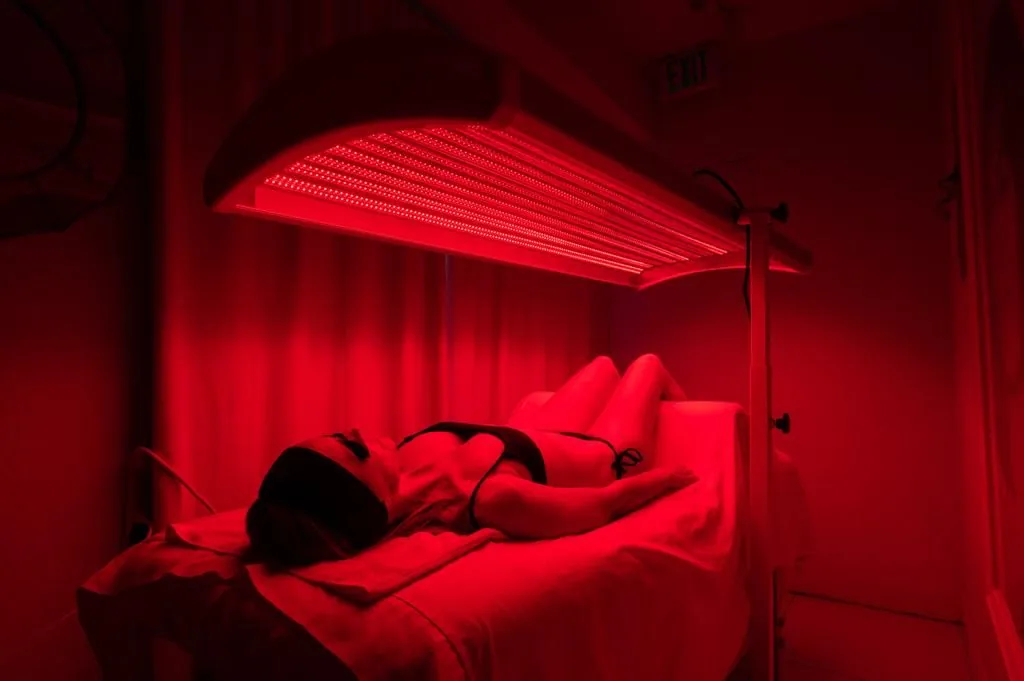
We offer both. Our Revolutionary Pro red light bed has more than 5,000 red LEDs and is booked as a 30-minute session for $360 at our spa inside Hulen Mall in Fort Worth. Red light is a cosmetic service, not medical care, and results vary from person to person.
Coverage is the biggest practical difference. On the bed, you lie down and the light reaches the body for the full session, from head to toe, at a consistent distance. There is nothing to hold, nothing to aim and no area you forget.
A handheld wand works the opposite way. It is small, so you move it across the skin and hold it over each spot for a set time. That is fine for a cheek, the jawline or the backs of the hands. It becomes tedious for anything larger, and most people find their routine quietly shrinks to the one or two areas they can reach easily. A panel sits in between. A tabletop panel covers the face and neck well. A larger floor panel can cover the torso or the backs of the legs, but only one side at a time. Only the bed treats the whole body evenly in one go.
A bed session is 30 minutes, and in that time the whole body has been treated. To cover the same area with a handheld, you would be holding a device over small patches of skin for far longer, and in practice almost no one does. With a panel, treating the front, then the back, then the face can take an hour or more across the week, before you count the days you skip.
There is also a difference in output. Small consumer devices are generally designed for simplicity at modest output. A full-body bed is designed to cover far more skin in one session. We do not claim that more light always means a better result.
The time that matters most is the time you will actually give it. A home routine depends on you, every day, for as long as you keep it up. The bed asks for 30 minutes on a day you have already set aside, and for busy people that is often the difference between a treatment that happens and one that does not.
Home devices have one clear advantage. They are there every day. If you can build a ten-minute session into a morning or evening routine, a handheld or a small panel gives the face a daily rhythm no spa schedule can match. That rhythm is the point. The face is small enough to treat in minutes, and short, regular sessions at home are a sensible way to keep up with the look between visits.
Home devices are also private and portable, and you pay once rather than per session. The bed requires a booking and a drive to Hulen Mall, even though the parking is free. The trade is scope. A home device suits the face on a daily rhythm. Only the bed covers the body, and no device on a nightstand changes that. Whichever you use at home, follow the instructions on distance, session length and eye protection.
The bed is the full-body option. More than 5,000 red LEDs line the Revolutionary Pro, so the body is treated at a fixed, even distance with no aiming, no counting and no missed patches on the back or the backs of the legs.
The session is also quiet, and it happens in the spa rather than at home. Ask us about eye protection and session timing when you arrive. For many people, a quiet half hour that is already on the calendar is easier to keep than a daily habit at home. Details on the session itself, including who should wait, are on our red light therapy page.
What the bed cannot do is show up at your house on a Tuesday night. It is a periodic treatment. A typical starting point is two or three sessions a week for the first month, then once a week, and the look it may support is gradual and maintained with ongoing sessions. It is not a single-visit fix.
We carry a small selection of at-home LED devices in the spa, and we will show you what is in stock and how to use it. In general, a handheld wand suits spot work on the cheeks, forehead, jawline and the backs of the hands, and a small panel suits the full face and neck in one sitting. Device prices vary by type and are quoted in the spa.
Used regularly, an at-home device may help the skin keep a smoother, more radiant look between spa sessions. Many clients notice the skin looks a little brighter after a few weeks of consistent short sessions. Some notice very little, and we say so. Results vary, and a home device is a maintenance tool rather than a replacement for a full-body session on site.
If you are shopping anywhere, not only with us, check that the at-home device lists its wavelengths. Consumer devices usually list red around 630 to 660 nm, and some add near-infrared around 800 to 850 nm. Our bed uses red LEDs only. Check that it explains how to protect your eyes. Follow the recommended distance and session length. Avoid any product that promises a result in a set number of days.
A simple pattern is to use the bed for the whole body on a schedule and a small home device for the face in between. As a typical starting point, that might mean the bed two or three times a week for the first month, then once a week to maintain, with a home device on the face a few evenings a week for ten minutes. That gives the body even, full coverage and gives the face the frequency a bed schedule cannot provide. For more on pacing, see our guide to how often to use the bed.
A bed session can also follow a facial on the same visit. There is nothing to rinse off, and downtime is typically minimal, though sensitivity varies. Prices for every option are on our pricing page.
A few people should check with a physician first, and this applies to the bed and to any home device. If you are pregnant, have a pacemaker, have cold urticaria, have an active skin infection, have had recent surgery, or take a medication that makes your skin sensitive to light, talk to your physician before booking or buying. If you are managing a skin condition such as melasma, rosacea or eczema, a dermatologist is the right first step.
If you want the whole body treated evenly and would rather have it done for you in 30 minutes, book the bed. If you mainly care about the face and you will actually use a device most days, a handheld or small panel is a reasonable place to start. If you want both, use the bed on a schedule and a home device in between. We are happy to talk this through before you spend anything, and we will say plainly which fit makes sense for you.
Not for the body. A handheld covers a small patch of skin at a time, so it suits the face and hands but is impractical for the torso, back or legs. The bed treats the whole body at once in 30 minutes. For the face alone, a handheld used consistently can be a reasonable choice.
Many people do, with the bed on a schedule and a home device on the face in between. Follow the distance and timer on the home device, keep your eyes protected with both, and let us know what you use at home so we can plan a sensible schedule. If you have a health condition or take a light-sensitizing medication, check with your physician first.
We carry a small selection of at-home LED devices in the spa. Ask at the front desk or when you book about what is in stock and how to use it, and we will help you decide whether one fits your routine.
Treatments at Vearitea Wellness Spa are cosmetic and wellness services, not medical care, and are not intended to diagnose, treat, cure or prevent any disease. Results vary from person to person. If you are pregnant, have a pacemaker, cold urticaria, an active skin infection, or have had recent surgery, talk to your physician before booking.
If a full-body session sounds like the right starting point, you are welcome to book the red light bed and we will talk through whether a home device makes sense alongside it.
Keep reading
WellnessTwo to three sessions a week for a month, then weekly, is a typical starting point. Why the rhythm matters, when to pause and what the research explores.
Read the guide
WellnessMany clients pair our red light bed with a facial or the infrared capsule. Here is the order we suggest, how long it takes, what the pair costs and aftercare.
Read the guide
WellnessA 30-minute session on our full-body red light bed is $360. Here is what it feels like, what the research explores, how often people come and who should wait.
Read the guide